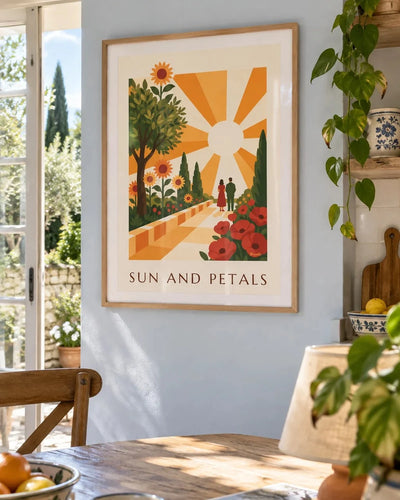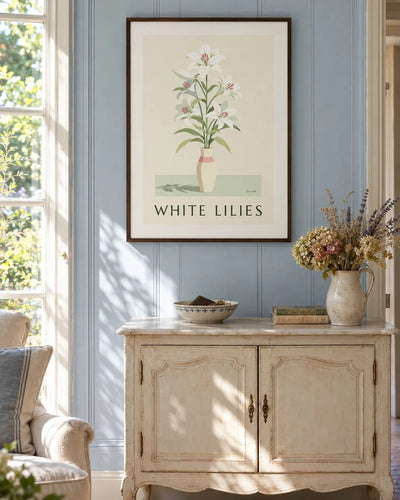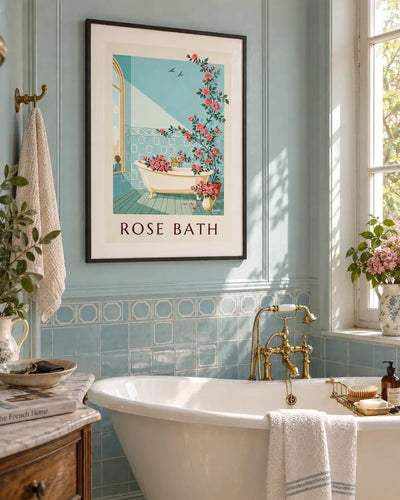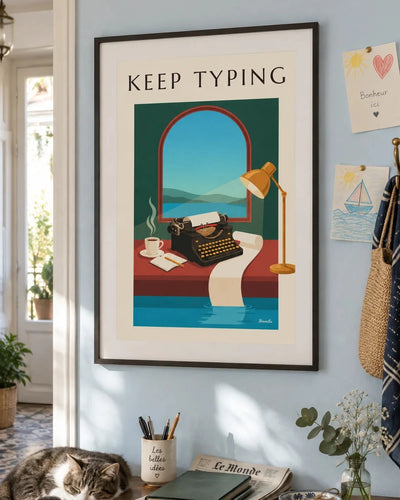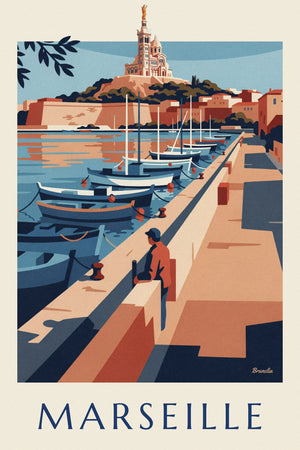
Travel posters: turn your walls into a travel agency
PLM, Wagons-Lits, ocean liners, the first airlines: between 1900 and 1960, the travel poster invented a visual language that has never been surpassed. A guide to bringing it into your home.

Key points
- 513 posters in the Travel posters collection, the 20 from this article in the table below.
- From $19.00 in A4, up to $74.00 in A0, 5 sizes for each poster.
- Printed in the United States on demand, free delivery from $69.
The table
The 20 posters at a glance


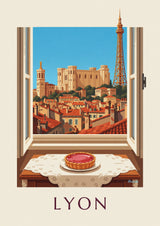

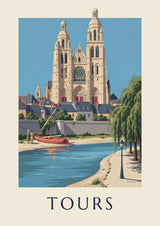





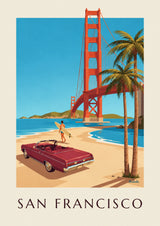


A travel poster is not like any other poster. It was drawn at a time when selling a train, an ocean liner or a plane meant making a destination irresistible in a single image, with no internet or video to flesh out the pitch. That constraint produced graphic masterpieces that have lost none of their effectiveness a century later.
3 travel styles coexist in the vintage world. The Belle Époque airlines (Air France, Pan Am) with their stylized planes and exotic destinations. The PLM railway companies with their monumental landscapes. And Cassandre’s transatlantic ocean liners, where the ship becomes a graphic sculpture.
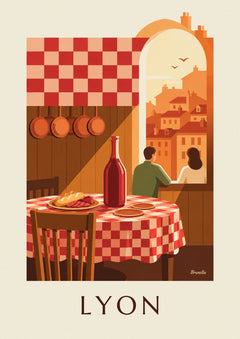
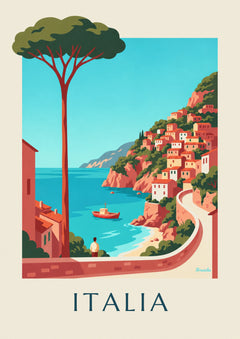
For a cohesive travel gallery wall, choose one style and stick to it. Unified frames (aged wood OR matte black metal), varied sizes (a dominant A1 + A3 satellites), even spacing. See our full collection of travel posters or browse by destination through our world city posters.
4 ages of the travel poster
From 1900 to 1960, the travel poster passes through 4 periods, each with its own signature. Knowing which one you hang is knowing what story you tell on your walls.
The Belle Époque (1900-1914) plays the ornamental card: women in long dresses, horses, grand hotels, a golden and pink palette. The Roaring Twenties (1920-1929) break free: flat areas of vivid color, pure lines, the first cinematic framing. Art Deco (1925-1940) geometrizes everything: the silhouette of an ocean liner becomes an assembly of cubes and stylized plumes of smoke (the Cassandre school). The golden age of ocean liners (1930-1960) returns to a certain stylized realism, more narrative.
A well-chosen poster brings an era into a room. Mixing all 4 ages on one wall creates chaos, unless you have a strong common thread (for example, the same destinations across 4 different eras).

3 iconic families to know
Railways (PLM, SNCF, ONCF)
Between 1880 and 1938, the PLM company commissioned more than 1,000 posters to sell trips to the South (French Riviera, Alps, Burgundy, Switzerland). Roger Broders is the name to remember for the 1920s-1930s. Later, the SNCF posters of the 1950s (Bernard Villemot, Hervé Morvan) updated the tradition with a more pop graphic style.
Shipping lines (Compagnie Générale Transatlantique, Cunard)
The French Line’s liner Normandie, promoted by Cassandre in 1935, is probably the most famous maritime poster in history. The British companies (Cunard, P&O) have their own masters: Tom Purvis, Frank Newbould, Edmund Vaughan-Wilkes.
The first airlines
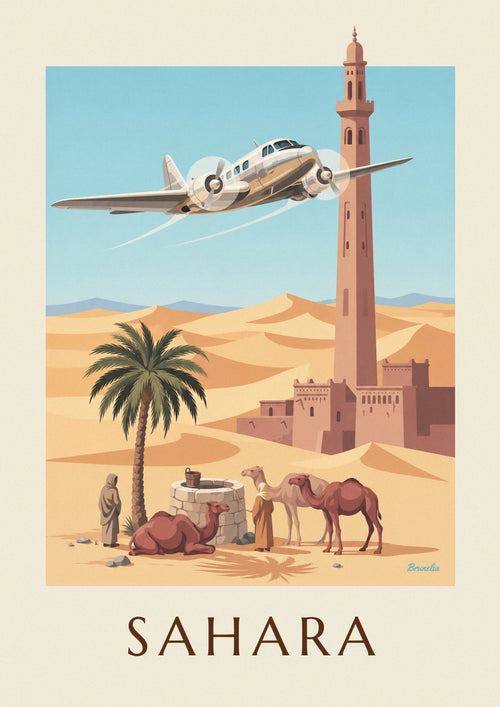
As early as 1933, Air France commissioned posters that define the modern imagery of air travel. Lucien Boucher, Roger de Valerio. Later, Pan Am, BOAC and Lufthansa joined the genre. An aviation poster works especially well in an office or a reading nook.

Creating a travel gallery wall
The geographic thread
7 to 9 posters from the same region of the world (all of France, Mediterranean Europe, Asia). The cohesion comes from the territory, and the eras can vary.
The chronological thread
5 posters from the same decade, for example the 1930s. The cohesion lies in the shared graphic signature. It only works if you know the period a little, otherwise the result looks random.
The color thread
3 to 6 travel posters that share a dominant tone (all cobalt and orange, or all sepia, or all pastel). It is the easiest thread to maintain and the most visually effective.

The right wall for a travel poster
A light wall (off-white, linen, pinkish beige) for high-contrast Art Deco posters. A dark wall (forest green, midnight blue) for golden Belle Époque posters, which glow against the dark. A bold colored wall (terracotta, sage green) for monochrome posters that play off the color.
Build this wall
3 posters from this article, at true scale


All 3 posters: $106.00
Frequently asked questions
You often ask us
Why do travel posters still work?
Because they were drawn at a time when travel had to be sold, which meant making a destination irresistible in a single image. That creative constraint is the source of their graphic effectiveness, which never ages.
What are the classics of vintage travel?
PLM posters (Roger Broders for the Alps and the French Riviera), Wagons-Lits (Cassandre), ocean liners (Normandie, Île-de-France), the first airlines (Air France in the 1930s), and Italian companies (Adriatica, Genova).
Do travel posters go with contemporary decor?
Very well. The geometric language of Art Deco posters (1920-1940) anticipates modern minimalism. A Cassandre poster in an all-white loft works as well as a skier poster in a chalet.
How do I create a travel-themed gallery wall?
Choose a common thread: geographic (a continent), chronological (a decade), or color (a dominant blue-white-red palette). Use 7 to 9 posters in an asymmetrical layout.
Should I favor originals or reprints?
Distinguish between an authenticated antique original, a reproduction of an identified work and a contemporary creation in a retro style. The choice depends on your interest in collecting, the provenance you are looking for and your budget. Check the characteristics of the print on offer rather than judging its quality by its style alone.
Keep exploring